Resistance bands offer a versatile and accessible entry point into strength training, proving ideal for beginners and seasoned athletes alike. These elastic bands,
available in varying tensions, provide a cost-effective alternative to traditional weights, enabling effective workouts at home, the gym, or while traveling.
Compact and lightweight, resistance bands facilitate personalized exercise routines, adaptable for seated, standing, or lying positions, enhancing overall fitness conveniently.
What are Resistance Bands?

Resistance bands are large elastic bands, typically made from latex or rubber, designed to provide varying levels of tension when stretched. They’re a remarkably versatile fitness tool, differing significantly from traditional weights by offering progressive resistance – meaning the tension increases as the band is stretched further.
These bands come in a multitude of forms, including loop bands (closed circles), therapy bands (continuous loops), and tube bands with handles, catering to diverse exercise preferences. Their portability and compact nature make them exceptionally convenient for workouts anywhere, anytime.
Unlike fixed-weight dumbbells or machines, resistance bands adapt to your strength level, making them suitable for all fitness levels, from beginners to advanced athletes. They’re frequently utilized in rehabilitation settings, assisting with muscle recovery and improving range of motion, but are equally effective for building strength and endurance.
Benefits of Using Resistance Bands
Resistance bands offer a plethora of advantages, making them a standout choice for fitness enthusiasts of all levels. Their affordability is a major draw, providing a cost-effective alternative to expensive gym memberships or bulky weight sets. Portability is another key benefit; easily packed for travel, they ensure workouts aren’t disrupted.
Beyond convenience, resistance bands promote functional strength, mimicking real-life movements and improving overall physical performance. They’re gentle on joints, reducing the risk of injury compared to heavier weights, making them ideal for rehabilitation or those with joint sensitivities.
Furthermore, bands provide constant tension throughout the entire range of motion, maximizing muscle engagement and promoting greater strength gains. They’re incredibly versatile, adaptable for a full-body workout targeting all major muscle groups, enhancing flexibility and stability simultaneously.
Types of Resistance Bands
Resistance bands aren’t a one-size-fits-all solution; they come in various forms, each suited to different fitness goals and preferences. TheraBands, or flat bands, are commonly used for rehabilitation and general strengthening, offering a wide range of resistance levels. Loop bands, also known as mini-bands, are ideal for lower body exercises, particularly targeting glutes and thighs, adding intensity to squats and lateral walks.
Tube bands with handles provide a more secure grip and are versatile for upper body workouts like bicep curls and tricep extensions. Figure 8 bands offer a unique shape, excellent for rotational movements and shoulder exercises. Material also varies, with latex being the most common, but options like fabric bands cater to latex allergies.
Choosing the right type depends on your workout style and needs, ensuring optimal effectiveness and comfort. Understanding these distinctions allows for a tailored and progressive fitness journey.

Full Body Resistance Band Workout Plan
This comprehensive plan utilizes resistance bands for a total-body workout, enhancing strength and endurance. It’s adaptable for all fitness levels, promoting accessible and effective training.
Warm-up Exercises (5-10 minutes)
Prior to a full resistance band workout, a dynamic warm-up is crucial for preparing muscles and joints, minimizing injury risk, and maximizing exercise effectiveness. Begin with Band Pull-Aparts, holding a band with arms extended, then pulling it apart, squeezing shoulder blades together – repeat for 15-20 repetitions.
Next, incorporate Arm Circles with Band, securing the band under your feet and performing small, controlled circles with your arms, both forward and backward, for 10-15 repetitions each direction. These movements increase blood flow and range of motion.
These simple exercises gently elevate your heart rate and activate key muscle groups, ensuring you’re adequately prepared for the more intense exercises to follow, optimizing your workout experience and results.
Band Pull-Aparts
Band Pull-Aparts are a fantastic exercise for activating the rear deltoids, rhomboids, and trapezius muscles – crucial for posture and shoulder health. Begin by holding a resistance band with an overhand grip, arms extended straight out in front of you at shoulder height.
Keep your elbows slightly bent and focus on squeezing your shoulder blades together as you pull the band apart, moving your hands outwards until they are roughly shoulder-width apart. Maintain a controlled movement throughout the exercise.
Slowly return to the starting position, resisting the pull of the band. Aim for 3 sets of 15-20 repetitions. This exercise is excellent for improving upper back strength and correcting rounded shoulders, contributing to better overall alignment.
Arm Circles with Band
Arm Circles with a Resistance Band are a simple yet effective exercise for strengthening the shoulders and improving mobility. Secure the resistance band under your feet, holding the ends with your hands, palms facing down. Maintain a slight bend in your elbows throughout the movement.
Begin by performing small, controlled circles forward with your arms, keeping your core engaged and back straight. Complete 20-30 repetitions in the forward direction, then reverse the motion and perform the same number of repetitions in a backward direction.
Focus on maintaining constant tension on the band and avoid swinging your arms. This exercise enhances shoulder stability and range of motion, making it a valuable addition to any warm-up or rehabilitation routine. Adjust band resistance as needed.
Lower Body Exercises
Resistance bands are incredibly versatile for sculpting and strengthening the lower body, offering a progressive challenge suitable for all fitness levels. These exercises can be easily incorporated into a home workout routine, requiring minimal space and equipment.
Key movements include Squats with Resistance Band, placed above the knees to activate glutes and quads; Glute Bridges with Resistance Band, looped around the thighs for enhanced glute engagement; and Lateral Walks with Resistance Band, promoting hip abduction and stability.
Don’t forget Hamstring Curls with Resistance Band, anchored securely, to target the back of the legs. Remember to maintain proper form throughout each exercise, focusing on controlled movements and engaging the core for optimal results. Adjust band resistance to match your strength and fitness goals.
Squats with Resistance Band
Squats with Resistance Band are a fantastic lower body exercise, effectively targeting your glutes, quads, and hamstrings while enhancing stability. To perform this exercise, select a resistance band appropriate for your fitness level and position it comfortably above your knees.
Stand with your feet shoulder-width apart, maintaining a slight bend in your knees. As you lower into a squat, ensure your back remains straight and your core engaged. The resistance band will create additional tension, intensifying the workout.
Focus on pushing your hips back as if sitting in a chair, keeping your weight in your heels. Drive through your heels to return to the starting position, squeezing your glutes at the top. Repeat for the desired number of repetitions, maintaining proper form throughout.
Glute Bridges with Resistance Band
Glute Bridges with Resistance Band are an excellent exercise for strengthening your glutes, hamstrings, and core. Begin by lying on your back with your knees bent and feet flat on the floor, hip-width apart. Place the resistance band around your thighs, just above your knees.
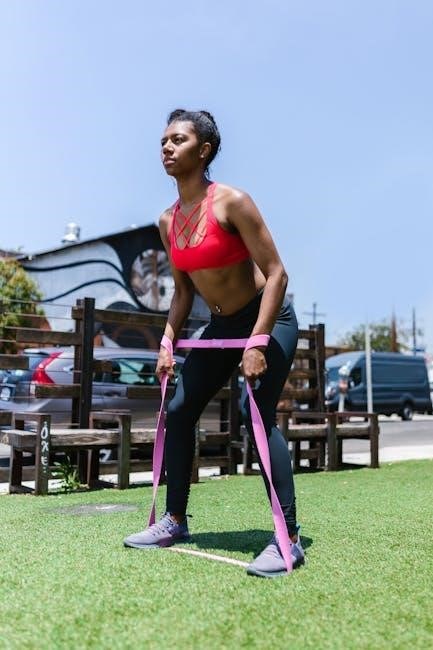
Engage your core and squeeze your glutes as you lift your hips off the floor, creating a straight line from your shoulders to your knees. The resistance band adds intensity, challenging your glute muscles further. Maintain a controlled movement throughout the exercise.
At the peak of the bridge, hold for a brief moment, focusing on the glute contraction. Slowly lower your hips back to the starting position, maintaining tension on the band. Repeat for the desired number of repetitions, ensuring proper form to maximize effectiveness.
Lateral Walks with Resistance Band
Lateral Walks with Resistance Band are a fantastic exercise for targeting your gluteus medius, crucial for hip stability and preventing knee pain. Begin by placing a resistance band around your ankles, or just above your knees for increased difficulty. Stand with your feet hip-width apart, knees slightly bent in a quarter-squat position.
Maintain the squat position and slowly step sideways with one foot, keeping tension on the band. Follow with the other foot, maintaining the band’s tension throughout the movement. Focus on keeping your core engaged and your back straight.
Take approximately 10-15 steps in one direction, then reverse and walk back to the starting point. This controlled movement effectively activates your outer glutes and thighs, improving lower body strength and stability.
Hamstring Curls with Resistance Band
Hamstring Curls with Resistance Band are an excellent exercise for isolating and strengthening the hamstrings, contributing to improved leg strength and athletic performance. Securely anchor a resistance band to a stable, low object – a table leg or sturdy furniture works well. Attach the other end of the band around your ankle.
Lie face down with your leg extended, maintaining a slight bend in your knee. Keeping your upper body stable, slowly curl your heel towards your glutes, contracting your hamstring muscles. Control the movement throughout the entire range of motion;
Slowly return to the starting position, resisting the pull of the band. Repeat for the desired number of repetitions. This exercise effectively targets the hamstrings, enhancing lower body power and flexibility.
Upper Body Exercises

Upper body resistance band exercises provide a fantastic way to build strength and definition without needing heavy weights. These exercises are incredibly versatile and can be adapted for various fitness levels. Focus on controlled movements and maintaining proper form to maximize effectiveness and prevent injury.
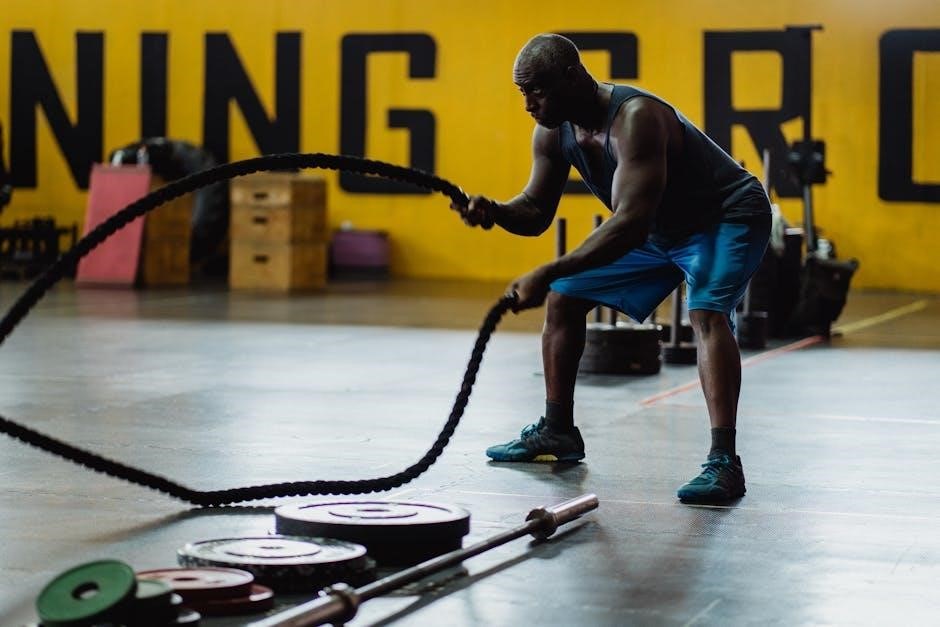
Key exercises include Bicep Curls, performed by standing on the band and curling upwards, Tricep Extensions, achieved by anchoring the band overhead and extending your arms, and Chest Presses, done by wrapping the band around your back and pressing your arms forward.
Don’t forget Shoulder Presses, where you stand on the band and press upwards, targeting the deltoids. These exercises are compact, lightweight, and ideal for home workouts, offering a cost-effective alternative to traditional gym equipment.
Bicep Curls with Resistance Band
Resistance band bicep curls are a highly effective exercise for isolating and strengthening the biceps muscles. To perform this exercise, begin by standing with your feet shoulder-width apart, firmly planted on the center of the resistance band.
Hold the ends of the band with your palms facing upwards, ensuring a slight tension on the band even at the starting position. Keeping your elbows close to your sides, slowly curl the band upwards towards your shoulders, squeezing your biceps at the top of the movement.
Control the descent back to the starting position, resisting the pull of the band. Maintain a stable core and avoid swinging your body to generate momentum. This exercise is easily adaptable for different resistance levels by choosing bands with varying tensions.
Tricep Extensions with Resistance Band
Resistance band tricep extensions are excellent for targeting the back of your upper arms, building strength and definition. Secure the resistance band under your feet, or attach it to a stable, low anchor point. Hold the band with an overhand grip, extending your arm overhead.
Keep your elbow close to your head throughout the exercise, and slowly extend your forearm upwards against the resistance of the band. Focus on contracting your triceps at the top of the movement, fully extending your arm.
Control the descent back to the starting position, resisting the band’s pull. Avoid locking your elbow at the top and maintain a stable core to prevent swaying. Adjust the band’s tension to modify the difficulty, ensuring proper form throughout each repetition.
Chest Press with Resistance Band
Resistance band chest presses effectively work your pectoral muscles, offering a convenient alternative to traditional weightlifting. Secure the band around your back, under your armpits, or anchor it behind you at chest height. Grip the ends of the band with your hands, palms facing forward.
Step forward to create tension in the band, maintaining a slight bend in your elbows. Press your hands forward, extending your arms straight out in front of your chest, mimicking a dumbbell chest press.
Focus on squeezing your chest muscles during the press. Slowly return your hands to the starting position, controlling the band’s resistance. Keep your core engaged and back straight throughout the exercise. Adjust the band’s placement or use a heavier band to increase the challenge.
Shoulder Press with Resistance Band
Resistance band shoulder presses are excellent for building strength and definition in your deltoids (shoulder muscles). To begin, stand on the middle of the resistance band with your feet shoulder-width apart, or secure the band under your feet.
Grip the ends of the band with your hands, palms facing forward, and bring your hands up to shoulder height, elbows bent at 90 degrees. Press your hands straight up overhead, extending your arms fully but avoiding locking your elbows.
Focus on controlled movements and squeezing your shoulder muscles at the top of the press. Slowly lower your hands back to the starting position, maintaining tension on the band. Adjust your foot placement or use a band with greater resistance to modify the difficulty.
Core Exercises
Resistance bands significantly enhance core workouts, adding challenge and versatility to traditional exercises. Engaging your core is crucial for stability and overall fitness, and bands provide consistent tension throughout each movement.
Russian Twists with Resistance Band involve looping a band around your feet and holding the ends while performing twisting motions, strengthening obliques. Wood Chops utilize the band anchored low, simulating a chopping motion to target core and rotational strength.
These exercises are adaptable for various fitness levels; adjust band resistance or range of motion as needed. Remember to maintain proper form—a braced core and controlled movements—to maximize effectiveness and prevent injury. Integrating resistance bands into your core routine offers a dynamic and effective path to a stronger, more stable core.
Russian Twists with Resistance Band
Russian Twists with Resistance Band are a fantastic exercise for targeting your obliques and enhancing core rotational strength. Begin by sitting on the floor with your knees bent and feet slightly elevated, or planted for stability. Secure a resistance band around your feet, holding the ends with both hands.
Maintaining a straight back and engaged core, twist your torso from side to side, bringing the resistance band with you. Focus on controlled movements, resisting the pull of the band throughout the exercise;
This added resistance intensifies the workout, promoting greater muscle activation. Perform 15-20 repetitions per side for optimal results. Remember to breathe consistently and avoid jerky motions to maximize effectiveness and minimize risk of injury.
Wood Chops with Resistance Band
Wood Chops with Resistance Band are a dynamic exercise that effectively works your core, obliques, and shoulders, mimicking the motion of chopping wood. Secure a resistance band to a stable anchor point at roughly waist height. Grasp the band with both hands, standing with your feet shoulder-width apart and a slight bend in your knees.
Initiate the movement by pulling the band diagonally across your body, as if chopping wood, rotating your torso and engaging your core. Maintain a straight back and controlled motion throughout the exercise.
Slowly return to the starting position, resisting the band’s pull. Perform 12-15 repetitions on each side. This exercise builds rotational power and improves core stability, contributing to functional fitness and athletic performance.
Advanced Resistance Band Exercises
For those seeking a greater challenge, advanced resistance band exercises elevate intensity and target muscle groups with increased complexity. Standing Rows with Resistance Band demand core engagement and back strength; secure the band and pull towards your torso, maintaining a straight back.
Single Leg Deadlifts with Resistance Band enhance balance and hamstring activation – loop the band around your feet and perform a controlled hinge movement; These exercises require proper form to maximize benefits and prevent injury.
Progressing to these movements demonstrates a solid foundation and allows for continued strength gains. Remember to select appropriate band resistance and prioritize controlled movements over speed. Combining these advanced exercises with foundational routines creates a well-rounded and effective workout regimen.
Standing Rows with Resistance Band
To perform Standing Rows with a resistance band, securely anchor the band at chest height, utilizing a sturdy object or stepping on the center of the band. Grip the ends of the band with palms facing each other, maintaining a slight bend in your elbows.
Engage your core and back muscles as you pull the band towards your torso, squeezing your shoulder blades together. Maintain a straight back throughout the movement, avoiding any rounding of the shoulders. Slowly return to the starting position, controlling the band’s resistance.
This exercise effectively targets the back muscles, promoting strength and improved posture. Focus on controlled movements and proper form to maximize benefits and prevent injury. Adjust band tension to match your fitness level.

Single Leg Deadlifts with Resistance Band
For Single Leg Deadlifts, stand on the center of the resistance band, holding one end in each hand. Maintaining a slight bend in your standing leg, hinge at the hips, extending the non-supporting leg straight back for balance.
Keep your back straight and core engaged as you lower your torso towards the ground, feeling a stretch in the hamstring of the standing leg. The resistance band adds intensity, challenging stability and strength.
Slowly return to the upright position, squeezing your glutes at the top of the movement. This exercise enhances balance, strengthens the posterior chain, and improves hamstring flexibility. Adjust band resistance based on your fitness level, prioritizing controlled movements.
Creating a Resistance Band Workout Routine
Designing an effective routine involves considering your fitness goals – strength, endurance, or rehabilitation. Begin with a full-body approach, incorporating exercises for all major muscle groups. Structure your workout with 3-4 sets of 10-15 repetitions for each exercise.
Prioritize proper form over resistance level, gradually increasing tension as you gain strength. Alternate between upper and lower body exercises to allow for recovery. Include warm-up exercises like band pull-aparts and arm circles, followed by a cool-down with stretching.
Variety is key; rotate exercises weekly to prevent plateaus and maintain engagement. Utilize online resources or PDFs for pre-designed routines, adapting them to your individual needs and available band resistance levels. Consistency is paramount for achieving results.
Resistance Levels and Progression
Resistance bands typically come in varying levels – light, medium, heavy, and extra heavy – indicated by color coding. Beginners should start with lighter resistance to master proper form and avoid injury. As strength increases, progressively move to higher resistance levels.
Progression can also be achieved by adjusting the band’s length; shortening the band increases resistance. Another method involves combining multiple bands for greater challenge. Listen to your body and increase resistance gradually, ensuring controlled movements throughout each exercise.
PDF workout guides often specify recommended resistance levels for each exercise. Don’t hesitate to modify based on your individual capabilities. Consistent progression is crucial for continued muscle development and achieving fitness goals. Remember, quality over quantity is vital.
Safety Precautions When Using Resistance Bands
Always inspect resistance bands before each use for any signs of wear and tear, such as cracks or tears. Damaged bands can snap during exercise, causing injury. Secure the band properly, ensuring it’s anchored firmly to a stable object or your own body.
Maintain a controlled and slow movement throughout each exercise to prevent snapping or losing control. Avoid overstretching the band, as this can also lead to breakage. Be mindful of your surroundings, ensuring sufficient space to move freely without obstructions.
PDF workout guides may offer specific safety advice; always heed those recommendations. If you experience any pain, stop immediately and consult a healthcare professional. Proper form is paramount; prioritize technique over resistance level.
Finding Resistance Band Workout PDFs
Numerous online resources offer downloadable resistance band workout PDFs, catering to various fitness levels and goals. A simple web search using keywords like “resistance band exercises PDF,” “resistance band workout plan,” or “band training guide” yields a wealth of options.
Websites dedicated to fitness, such as those of certified personal trainers and health publications (like Women’s Health), frequently provide free PDFs. Platforms like Pinterest also curate collections of workout routines, often linking to downloadable resources.

When selecting a PDF, consider its credibility and clarity. Look for guides created by qualified professionals and those that include detailed exercise instructions and visual demonstrations. Always prioritize safety and proper form when following any workout plan.
Resistance Bands vs. Traditional Weights
Resistance bands and traditional weights both effectively build strength, but differ in their application and benefits. Weights provide consistent resistance throughout a movement, while bands offer progressive resistance – becoming harder as they stretch.
Bands are exceptionally portable and affordable, making them ideal for home workouts or travel, unlike bulky weights. They also place less stress on joints, potentially reducing injury risk, and are suitable for rehabilitation exercises.
However, achieving maximal strength gains comparable to heavy weightlifting can be challenging with bands alone. Weights allow for greater load progression, crucial for advanced strength training. Ultimately, the best choice depends on individual goals, access, and preferences.

Cool-down and Stretching (5-10 minutes)
Concluding your resistance band workout with a proper cool-down and stretching routine is crucial for muscle recovery and flexibility. Spend 5-10 minutes performing static stretches, holding each stretch for 20-30 seconds.
Focus on the muscle groups worked during your session, such as hamstrings, quads, biceps, triceps, and shoulders. Gentle stretches like hamstring stretches, quad stretches, and arm across-the-body stretches are beneficial.
Deep breathing during stretching enhances relaxation and improves blood flow. A thorough cool-down minimizes muscle soreness and reduces the risk of injury, ensuring a safe and effective workout experience. Prioritizing this phase is as important as the workout itself.
